
How to create a custom export
- Click on Settings -> Import & Export
- Open Custom Export.
- Select the type of data you want to report on, such as cars, contracts, or employees.
- Choose the fields you want to include.
- Apply any relevant filters or date ranges.
- Export the data for further analysis.
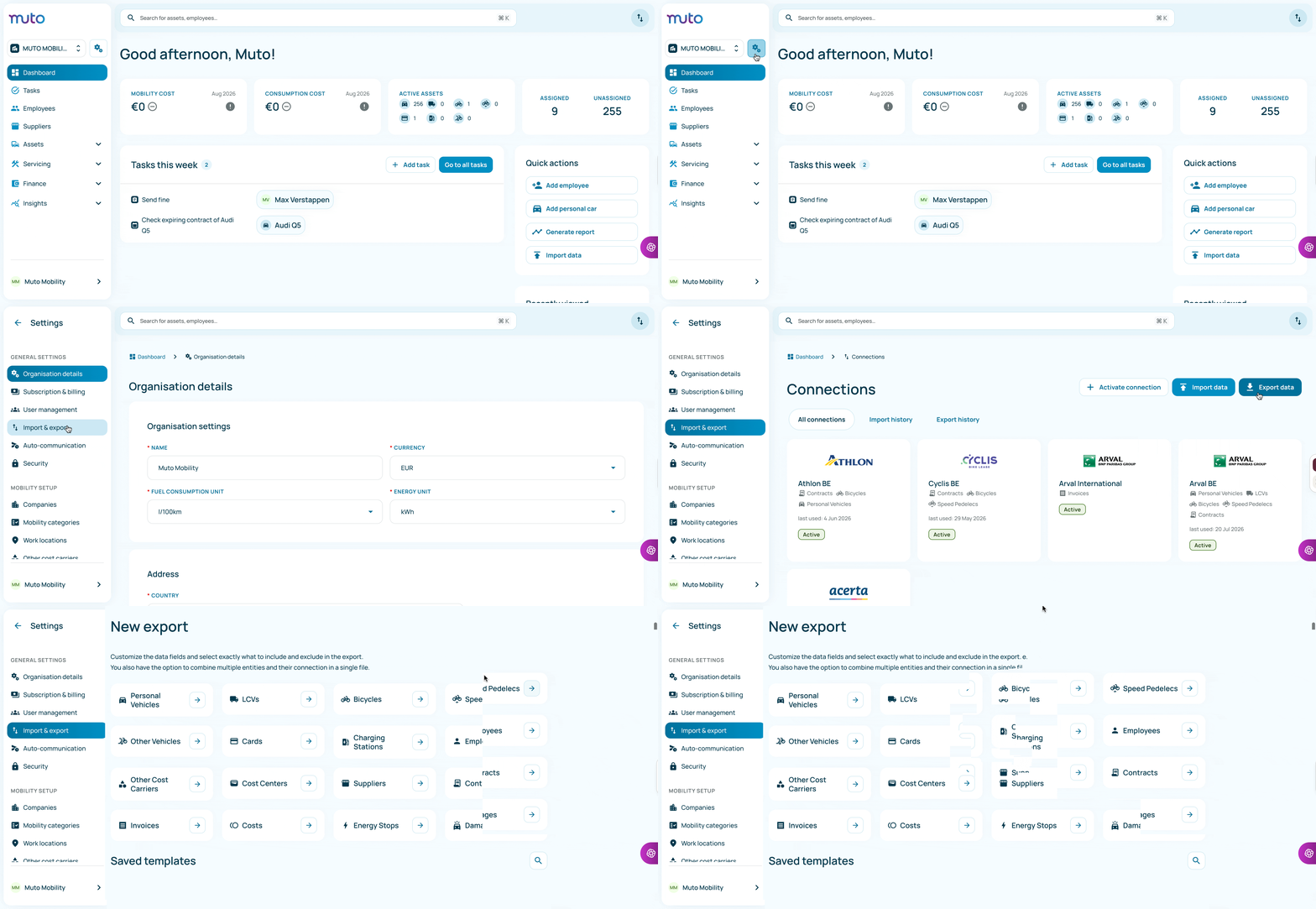
For recurring reporting, save your custom export as a template using the same fields and filters each time. You can then download that template again for each reporting period. The export will include the latest available data at the time you run it, so you can use the same setup when a new month begins.
Reporting examples
Contract changes
Use a recurring export to identify changes to contract details, such as:
- Contract duration
- Lease amount
- Contracted kilometres
- Contract start or end date
Recommended fields include:
- Contract ID
- Car ID or license plate
- Employee ID
- Contract start and end dates
- Contract duration
- Lease amount
- Contracted kilometres
Match records using the contract ID, then compare the relevant values with the previous export.
Newly activated cars
To report on cars activated during a particular month, include:
- Car ID
- License plate
- Car status
- Activation date
- Make and model
- Assigned employee or cost center
Filter the activation date to the reporting month. To track month-over-month performance, compare the number of activated cars with the previous month.
Newly archived cars
To identify cars archived during the reporting month, include:
- Car ID
- License plate
- Car status
- Archive date
- Assigned employee or cost center
Filter the archive date to the relevant month. If an archive date is not available, compare consecutive exports and identify cars whose status changed to Archived.
Employee cost center changes
To monitor changes to employee cost centers, include:
- Employee ID
- Employee name
- Email address
- Cost center
- Company or department
Match employees using their employee ID and compare the current cost center with the previous month’s export.
Frequently Asked Questions (FAQ):
Q: What file formats are supported for Custom Exports?
A: You can export data in Excel (.xlsx) and CSV (.csv) formats. Excel is recommended for quick formatting and pivot tables, while CSV is ideal for importing into external payroll, ERP, or BI tools.
Q: Can I save my export settings so I don't have to rebuild them every month?
A: Yes. Once you configure your entities, columns, and default filters, click Save as Template at the top right of the screen. Give it a descriptive name (e.g., "MoM Fleet Activations" or "Monthly Cost Center Changes"). Your saved templates will be accessible directly from the Custom Export dashboard.
Q: How up to date is the data in Custom Export?
A: Custom Export pulls live data directly from the system. Any status change, new assignment, or contract update saved in the platform is immediately available in your export.
Q: How can I run Month-over-Month (MoM) comparisons?
A: Use the date range filters on audit or event fields:
- For new activations / deliveries: Filter by
Delivery DateorCreation Datewithin the previous calendar month. - For offboarded / archived assets: Filter by
Archived DateorReturn Datewithin the target month. - For contract or employee changes: Filter by
Last Modified Datewithin the selected period.
To make side-by-side analysis seamless, keep the column order identical across monthly runs so you can easily compare sheets using Excel formulas (like VLOOKUP or XLOOKUP).
Q: Can I combine multiple entities (e.g., Drivers, Vehicles, and Contracts) into a single export?
A: Yes. When building your export, select your primary entity (e.g., Vehicles), then use the Connect Related Entities option to include fields from related entities such as Employees (Driver), Contracts, and Cost Centers.
Q: Why are some fields blank in my exported file?
A: A field appears blank if the information has not been recorded in the platform (e.g., an unassigned vehicle will not have driver or cost center details, or a contract without an excess mileage rate recorded will show that cell as empty).